
When your operation needs a properly scoped solution
Axial fans are common in general ventilation, wall extraction and some industrial air-moving duties. They can move large volumes of air in suitable conditions, but long restrictive duct runs may call for a different selection. We help facility teams distinguish a straightforward ventilation requirement from a more demanding process extraction application.
What we review on site
We consider the location of heat or stale air, available inlet paths, wall or roof openings, airflow obstruction and the fan actual duty. Fault-finding covers noisy operation, damaged blades, loose guards, motor problems and reduced movement of air caused by blocked openings. The surrounding louvres or weather protection may be as important as the fan itself.
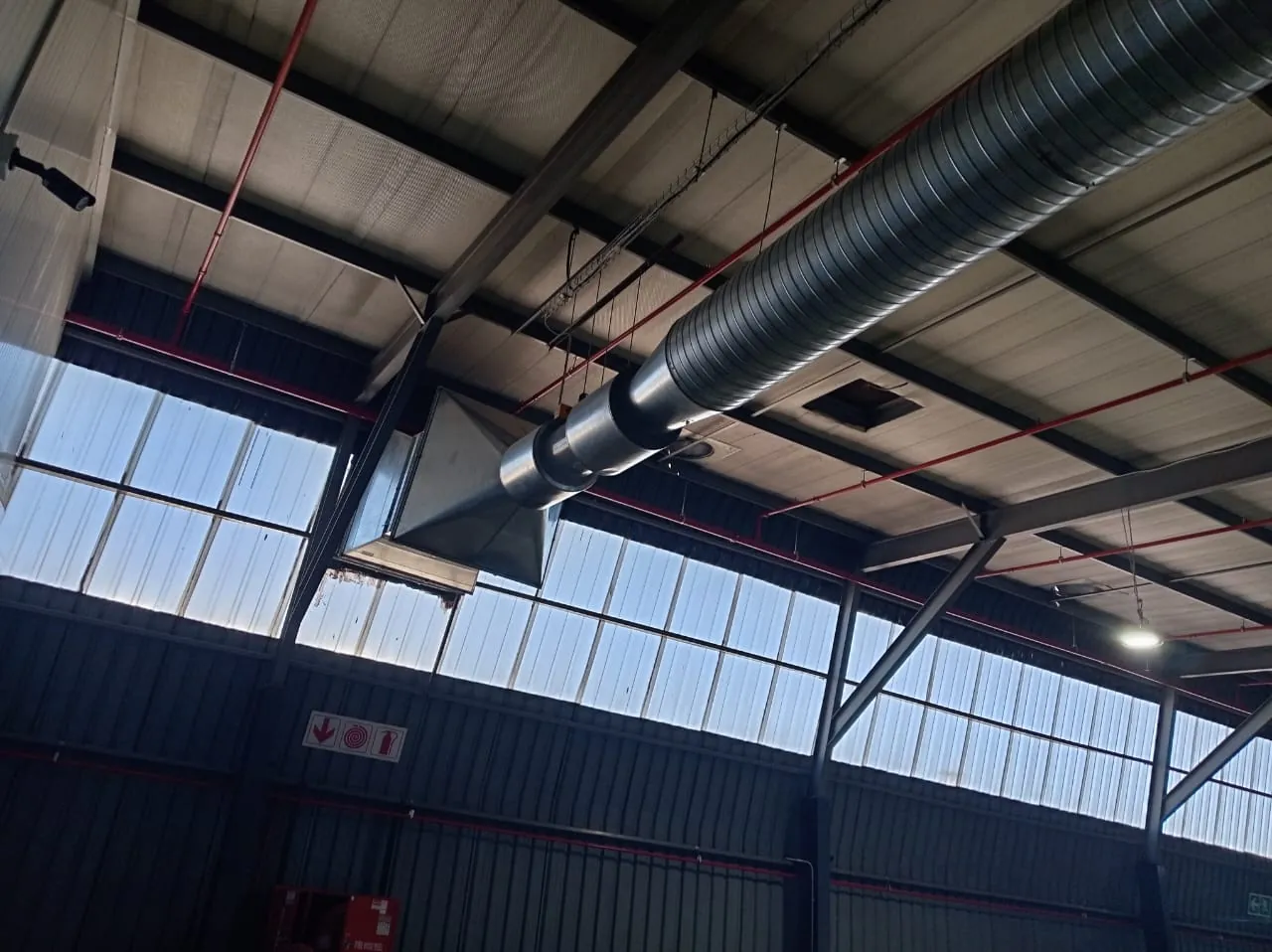
How we approach the work
Installation and repair work can cover fan replacement, mounting or connection improvements and accessible mechanical faults. We discuss whether the building needs several extraction points rather than one oversized unit. For a warehouse or factory, distribution of airflow should be considered alongside total fan capacity.
Technical suitability and safe operation
An axial fan designed for normal room air is not automatically suitable for corrosive fumes, hot exhaust or hazardous dust. Those conditions must be declared before any equipment is selected.
Information that helps us prepare your quotation
Provide the approximate space or process, opening dimensions, existing fan photographs, problems observed and operational hours. We can then consider the appropriate site review and equipment brief.
Ventilation distribution
A very high-flow wall fan may still leave occupied areas without effective air movement if inlets, obstructions and fan placement are poorly arranged.
Equipment and operating considerations
Axial fans can shift substantial volumes of air when the system offers relatively low resistance, but performance can fall sharply when additional duct bends, filters or restrictive outlets are added. We distinguish a free-air ventilation requirement from a ducted process extraction duty before selecting an axial arrangement. Blade condition, rotation direction, motor mounting and guard clearances are relevant during a repair. For plant replacements, share the fan plate, mounting dimensions, system opening, air temperature and any previous alterations that changed resistance.
Planning the project with your operations team
Where axial extraction performs well
Axial fans suit many high-airflow, relatively low-pressure applications, including wall and roof ventilation. Their performance can deteriorate sharply if connected to restrictive ducting, filters or weather cowls beyond the intended duty. We review intake and discharge restrictions, louvers, protective guards and make-up air rather than assuming a larger diameter will solve poor circulation.
Repair considerations for wall and roof units
Blade condition, mounting security, bearing noise and motor protection are important on constantly operating equipment. On elevated units, access platforms and safe isolation may account for a material part of the repair scope. Corrosion around mounting frames and weather seals should be assessed when replacing a rooftop or external fan, not hidden by a new motor installation.